Hip Arthritis
Arthritis can affect any joint but is most common in weight-bearing joints such as the hip. It is wear and tear of the joint cartilage, narrowing the joint space and causing pain and stiffness. It develops gradually, and symptoms often progress with it. Diagnosis is confirmed with X-ray.
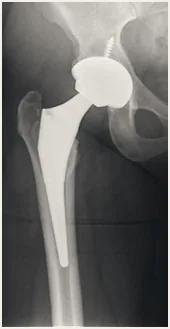
Along with pain and stiffness, patients may experience nighttime discomfort, loss of motion, and difficulty walking long distances. There is no cure for arthritis; once cartilage is damaged, it cannot be replaced.
Several conservative options help manage symptoms: anti-inflammatory medication, periodic cortisone injections into the joint, and physical therapy to regain motion and strength.
Surgical treatment is a hip replacement, which removes the arthritic joint surfaces and replaces them with an artificial joint. Physical therapy follows to regain motion and strength.
Hip Labral Tears
The hip labrum is a thick cuff of tissue around the joint that provides stability. Tears can develop from repetitive trauma, degeneration, a single injury, or variations in how the hip joint developed.
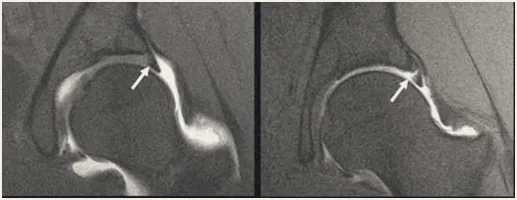
Symptoms typically include groin or buttock pain, painful rotation of the hip, and a catching sensation when changing positions. Diagnosis is made by physical exam and a specialized MRI called an MRI arthrogram.
Treatment focuses on reducing inflammation and strengthening the hip with physical therapy. In some cases surgery is necessary, either debriding the labrum or repairing it to the bone with anchors. Often a bony decompression is also performed to give the labrum more room.
Greater Trochanteric Bursitis
On the outside of the hip is a bony prominence called the greater trochanter, where the gluteal and hamstring muscles attach. A fluid-filled sac called a bursa overlies it; inflammation of this bursa causes pain on the outside of the hip.
It usually develops over time, although it can follow direct trauma. Symptoms include pain and achiness over the outside of the hip and buttock, burning and tenderness, and sometimes pain radiating down the outside of the leg along the IT band. Diagnosis is primarily by physical exam; MRI can help.
Treatment consists of reducing inflammation and physical therapy to stretch the hamstrings, gluteal muscles and IT band. A cortisone injection into the bursa is common. The condition usually responds well to conservative care; a surgical option exists for refractory cases.
Piriformis Syndrome
Piriformis syndrome causes pain over the buttock and back of the hip, often described as burning, that typically radiates down the back of the leg to the knee.
The piriformis is a small triangular muscle that lies over the sciatic nerve. When it is tight, it presses on the nerve and causes burning and achiness. Diagnosis is made by physical exam; an MRI is often used to rule out other causes.
It usually develops over time and can become chronic. Treatment centers on stretching and anti-inflammatory medication. In severe, recurrent cases, a surgical release of the piriformis can take pressure off the sciatic nerve.