Arthroscopic surgery

Rotator Cuff Repair

An outpatient, arthroscopic repair that reattaches torn rotator cuff tendon to bone with small suture anchors.

At a glance

Setting
Outpatient — home the same day
Approach
Arthroscopic, three or four small incisions
Surgery time
Approximately 1½–2 hours
Sling
Six weeks
Physical therapy
Three to four months
Full strength
Typically 9–12 months

Typical timelines. Your plan will be tailored to your condition, procedure and goals.

How it works

Minimally invasive, step by step.

Scroll to follow the procedure. An illustration for general understanding; Dr. Ganjianpour will walk you through the details of your own surgery.

  1. 01

    Three or four small incisions

    Instead of one large opening, the repair is done through three or four small incisions around the shoulder.

  2. 02

    A camera inside the joint

    A small camera, the arthroscope, shows the inside of the shoulder on a screen, so the tear can be assessed and treated precisely.

  3. 03

    Anchored back to bone

    Small non-metallic suture anchors reattach the torn tendon to the bone, where it heals over about six weeks.

  4. 04

    Home the same day

    Surgery takes approximately 1½–2 hours, and patients go home later the same day.

Recovery timeline

What recovery looks like.

Keep scrolling to move through recovery, or select a milestone. Typical timeline from the practice's protocol; your plan will be tailored to you.

Day 0

Surgery

Outpatient arthroscopic repair, approximately 1½–2 hours. You go home the same day, in a sling.

Weeks 0–6

Protect the repair

Sling immobilization while the tendon heals back to the bone, with specific instructions for a home exercise program.

Week 6

Sling off, therapy begins

After about six weeks of healing, physical therapy begins to regain motion and strength.

Months 3–4

Motion returns

Most patients recover their full range of motion after three to four months of physical therapy.

Months 9–12

Full strength

Most patients regain full strength between nine and twelve months. Outcomes vary with tear size, tissue quality, age and adherence to post-operative instructions.

01

Repair or debridement

If the tear is small and does not involve the full tendon thickness, debridement may be performed to clean up the torn portion while leaving the intact tendon alone. Larger, full-thickness tears require anchors to fix the tendon back to the bone.

Bone spurs overlying the rotator cuff are also removed, giving the repaired tendon more room to move without impingement.
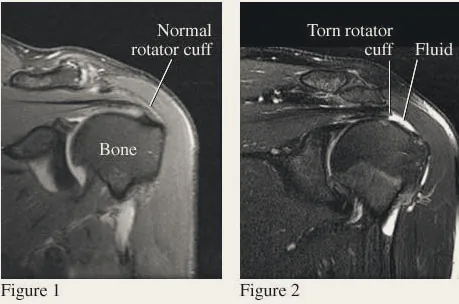
MRI comparison: normal rotator cuff (left) and torn rotator cuff (right).
Fig. 01MRI comparison: normal rotator cuff (left) and torn rotator cuff (right).
02

Outcomes

Outcomes vary with several factors, including the size of the tear, how long it has been present, the quality of the tendon tissue, age, the degree of retraction and muscle atrophy, and adherence to post-operative instructions. After recovery, most patients are pain-free and return to their pre-injury activities.

—

Related conditions

Begin here

Schedule a consultation

Call the office and our team will find a time that works for you.

(310) 855-0751